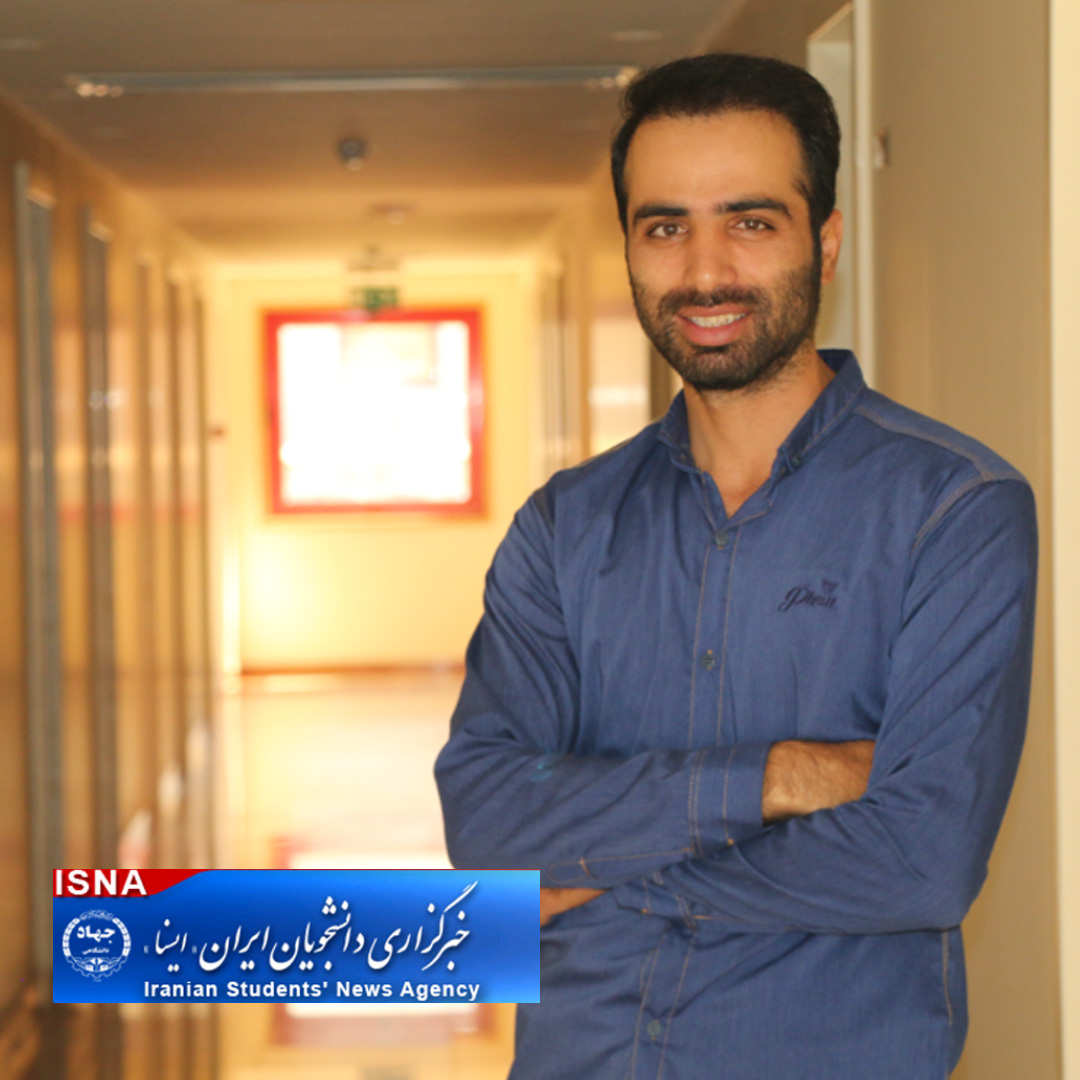
A PhD student of geophysics-seismology, Mr Mohsen Ranjbar Hajiabadi, has given an interview to the ISNA News Agency on seismic anisotropy and earthquake wave behaviour.
A graduate of geophysics at the Institute for Advanced Studies in Basic Sciences (IASBS), Mr Ranjbar said seismic anisotropy provides the possibility of more accurate knowledge of the earth's crust structure and active tectonic stresses by revealing changes in the speed and direction of shear waves propagation, a subject that has been investigated in a university research project in the south-east of Zagros and Qeshm Island.
Mohsen Ranjbar Hajiabadi stated in an interview with ISNA, referring to his thesis, that this research has been conducted under the guidance of Dr Farhad Sabbaghi and Dr Farzam Yaminifard and has addressed the investigation of seismic anisotropy of the upper crust in the south-east of Zagros and Qeshm Island with a focus on seismic data recorded in these areas.
He said that seismic anisotropy is one of the important tools for recognising the physical characteristics of the earth's crust and plays an important role in interpreting the behaviour of earthquake waves, especially in tectonically active regions.
Explaining the concept of seismic anisotropy, Mr Ranjbar added that in an ideal state, if the earth's crust were completely isotropic, seismic waves would have the same behaviour regardless of the direction of propagation, but in reality, the earth's crust is considered an anisotropic environment due to the alignment of some minerals, micro-cracks, fractures, and alternating sedimentary layers.
According to this researcher, such an anisotropic environment causes the shear wave to divide into two fast and slow components with polarisations approximately perpendicular to each other when passing through it, a phenomenon known in seismology as "shear wave splitting".
Referring to the theoretical foundations of the research, Mr Ranjbar said that in the upper crust of the earth, the main origin of anisotropy is a network of tiny cracks and fractures formed under the influence of the tectonic stress field.
These cracks usually have an alignment consistent with the direction of the maximum horizontal stress (SHmax) of the regional or local area.
For this reason, investigating the direction of the fast shear wave polarisation can provide an indirect but correct image of the direction of active stresses in the region.
Stating that anisotropy does not have the same behaviour in all parts of the crust, the researcher added that in shear zones around active faults, the direction of anisotropy is usually consistent with the shear structure and the direction of the faults, whereas outside these zones, the anisotropy pattern is more reflective of the regional or local stress field.
According to him, this very difference causes seismic anisotropy to be used as a diagnostic tool to identify anisotropy factors in the upper crust.
Referring to the technical parts of the thesis, Mr Ranjbar explained that in the simplest case, if a shear wave passes through an anisotropic layer, it divides into two components with approximately perpendicular polarisation, but in some conditions, we may encounter several anisotropic layers.
He added that in the case where a shear wave passes through two anisotropic layers with different directions, the wave undergoes splitting again in the second layer after passing through the first layer, and in total, it can lead to four shear wave components.
Mr Ranjbar noted that in many cases, the effect of the last anisotropic layer near the surface will be dominant on the recorded shear waves, and this issue makes extracting information related to the direction of anisotropy of deeper layers accompanied by uncertainty.
He emphasised that comparing the time delay indicates that the intensity of anisotropy observed in the upper crust in Qeshm Island is mainly reflective of shallow young anisotropic structures, whereas in the south-east of Zagros, in addition to shallow young anisotropic structures, deep old structures also control the anisotropy of the region.
Referring to the application of the thesis results, Mr Ranjbar said that although such research does not directly lead to earthquake prediction, more accurate knowledge of the upper crust structure, the direction of stresses, and the behaviour of seismic waves is one of the main bases for earthquake risk assessment, improving seismic models, and designing safe structures.
The results of this research can be used in future studies of the south of the country, especially in seismic-prone areas with sensitive infrastructure.
According to ISNA, the results of the research activities of this geophysics researcher have so far led to the publication of several scientific articles in reputable international journals.
The main focus of these researches has been on seismic anisotropy of the upper crust, seismic imaging of the crust structure using seismic noise autocorrelation and P-wave coda, as well as simulating the peak strong ground motion caused by large earthquakes.
Mr Ranjbar has so far succeeded in publishing scientific articles in journals such as Geophysical Journal International and Natural Hazards and has presented the results of his researches at international and national conferences on seismology and earthquake engineering.
In 2022, his work was selected as an accepted project by the Martyr Ahmadi Roshan National Elites Foundation.
Mr Ranjbar is currently a PhD student of geophysics (seismology) at the Institute for Advanced Studies in Basic Sciences (IASBS) and continues his researches focusing on the crust structure and seismic risk of the Iranian plateau.
Tue, 24 Feb 2026
Developed by the IASBS Computer Centre
IP Address:[216.73.216.7] Browser: Mozilla/5.0 AppleWebKit/537.36 (KHTML, like Gecko; compatible; ClaudeBot/1.0; +claudebot@anthropic.com)