According to the university’s Public Relations Office, a themed collection in the international journals Nanoscale and Nanoscale Advances, entitled ‘Magnetic Nanoparticles: From Massart Method to a Cascade of Innovations’, has selected the latest research by the university’s Department of Chemistry as a notable achievement in nanotechnology and green chemistry. The paper draws on research by the master’s graduate, Maryam Faraji, in collaboration with the researchers, Dr Fariborz Mansouri, Prof Babak Karimi, and Prof Hojatollah Vali, and was published in volume 17 of Nanoscale, pages 18161–18172.
The collection’s guest editors and editorial team, drawn from leading universities and research institutions worldwide, including Sorbonne University in France, University College London in the UK, the Italian Institute of Technology, Case Western Reserve University in the United States, and the universities of Bordeaux and Toulouse in France, formally commended the university’s research team and included the paper alongside 54 selected research and review articles from around the world in this joint themed collection.
Scientific details and technological significance
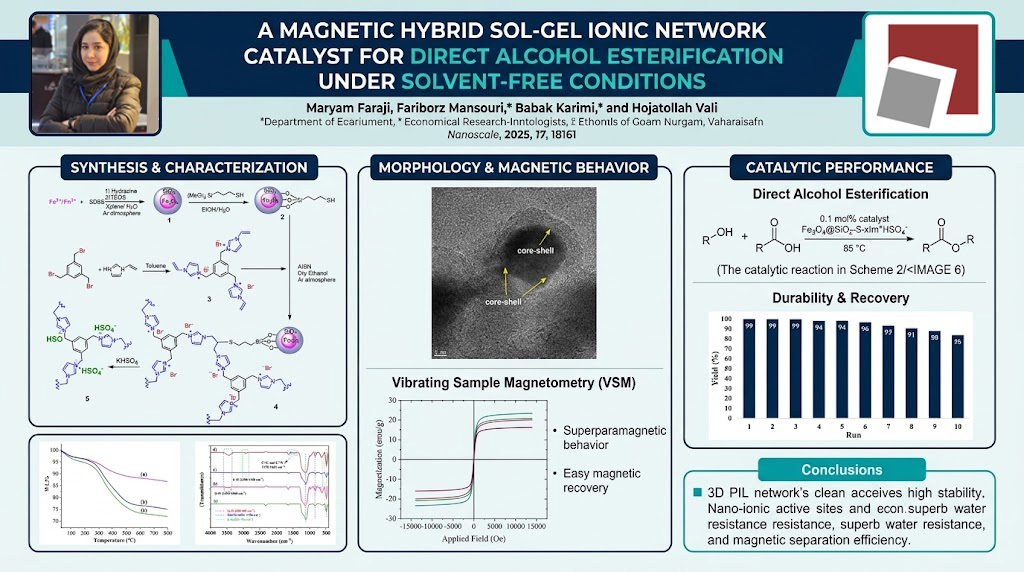
The direct esterification of alcohols is a key process in the synthesis of organic compounds, pharmaceutical precursors, and biofuels. Traditionally, it involves corrosive acids and generates environmentally harmful wastewater. This research introduces a recoverable acidic catalyst comprising interconnected magnetic nanoparticles (MINN) for the direct esterification of alcohols under solvent-free conditions.
The main findings and features of this achievement are:
The selection of this work by leading scientific bodies reflects international scientific interest in, and recognition of, the pioneering ideas underpinning this research group’s work.
Official Royal Society of Chemistry announcement:
Original paper in Nanoscale:
Thu, 05 Nov 2026
Developed by the IASBS Computer Centre
IP Address:[216.73.217.122] Browser: Mozilla/5.0 AppleWebKit/537.36 (KHTML, like Gecko; compatible; ClaudeBot/1.0; +claudebot@anthropic.com)